
Introducing CUTS:
Crude Assay Management Software
Every refinery decision begins with an understanding of the crude oil being processed. Whether the objective is refinery planning, refinery scheduling, crude blending, LP optimization, or process simulation, reliable results depend on accurate and internally consistent crude assay data. Unfortunately, crude oil assays are often obtained from different laboratories, crude suppliers, or historical databases, making them difficult to compare or use directly in engineering studies.
CUTS is a Crude Assay Management Software developed by Prometheus Systems to transform incomplete, inconsistent, or differently formatted crude oil assay data into a complete and internally consistent crude oil characterization. Using proprietary multidimensional regression and advanced data reconciliation techniques, CUTS reconstructs each crude across the entire boiling range, creating a comprehensive crude assay database that can be queried for the properties of any required fraction.
Instead of manually reconciling different laboratory assays or estimating missing values, refinery engineers can work from a single, consistent source of crude information. CUTS generates a detailed representation of the crude as pseudo-components (narrow 10°C cuts) with calculated crude oil properties that accurately reflect the original assay while preserving the natural shape of the TBP curve and other reported property trends.
The resulting crude characterization provides a reliable technical foundation for feedstock evaluation, crude selection, refinery planning, refinery scheduling, crude blending, LP optimization, and process simulation, helping engineers reduce uncertainty and improve the consistency of downstream engineering studies.
Why Accurate Crude Assays Matter
Every crude oil is unique. Its processing behaviour, product yields, and quality depend on the distribution of physical and chemical properties throughout the boiling range. For this reason, a reliable crude assay is one of the most important engineering inputs for refinery planning, refinery scheduling, crude blending, LP optimization, and process simulation.
In practice, however, crude oil assay data rarely arrives in a complete or standardized form. Assays may originate from different laboratories, crude suppliers, published crude oil databases, or historical refinery records. They often use different cut points, report different property sets, or contain gaps in the available information. Some assays are based on True Boiling Point (TBP) distillation data, others on ASTM D86 results or partial laboratory measurements, making direct comparison difficult.
These differences create significant engineering challenges. Before a crude can be evaluated or introduced into refinery models, engineers frequently need to perform assay validation, data reconciliation, estimate missing properties, or manually adjust fractions to obtain a consistent assay. This work is time-consuming and can produce different results depending on the assumptions made by individual users.
Because every downstream engineering study depends on the quality of its input data, inconsistencies introduced at the crude assay stage propagate throughout the entire workflow. They can affect feedstock evaluation, crude selection, refinery economics, crude blending, and the accuracy of planning and simulation models. Establishing a complete and internally consistent crude characterization before these activities begin provides a common technical foundation for more reliable engineering decisions and reduces uncertainty across refinery operations.
Complete Crude Oil Characterization
The resulting crude assay library acts as a structured crude database for planning and engineering applications. A laboratory crude oil assay typically reports properties only for selected petroleum fractions and cut points. While this information is essential, it does not always provide the continuous and internally consistent representation required by modern refinery planning software, refinery scheduling software, or process simulation tools.
CUTS overcomes this limitation by creating a complete crude oil characterization that represents each crude across its entire boiling range. Rather than treating the reported fractions as isolated data points, the software reconstructs the crude as a continuous distribution of pure components and pseudo-components, allowing the crude oil properties of any fraction to be calculated consistently. The resulting crude characterization provides a unified representation of the crude, independent of the source, format, or completeness of the original assay.
This approach transforms individual laboratory measurements into a structured crude assay database that can be queried for the properties of any required fraction. Engineers are therefore no longer limited to the cut points reported in the original assay but can work with a complete characterization suitable for feedstock evaluation, crude selection, crude blending, LP optimization, refinery planning, and process simulation. By establishing a common technical basis for every study, CUTS helps ensure that all downstream engineering activities start from the same consistent description of the crude.
Proprietary Multidimensional Regression
The quality of a crude oil characterization depends not only on the quantity of laboratory data available, but also on how consistently that data is interpreted. A typical crude oil assay may contain measurements originating from different laboratories, testing methods, or reporting standards, with incomplete property sets and non-uniform cut points. Simply interpolating the available values is rarely sufficient to produce a reliable engineering model.
CUTS addresses this challenge using a proprietary multidimensional regression algorithm specifically developed for crude assay management. Rather than evaluating each property independently, the algorithm analyzes the relationships between multiple assay properties simultaneously and performs data reconciliation to produce a consistent assay across the entire boiling range. The objective is not merely to estimate missing values, but to reconstruct a technically coherent representation of the crude that remains consistent with the available laboratory data.
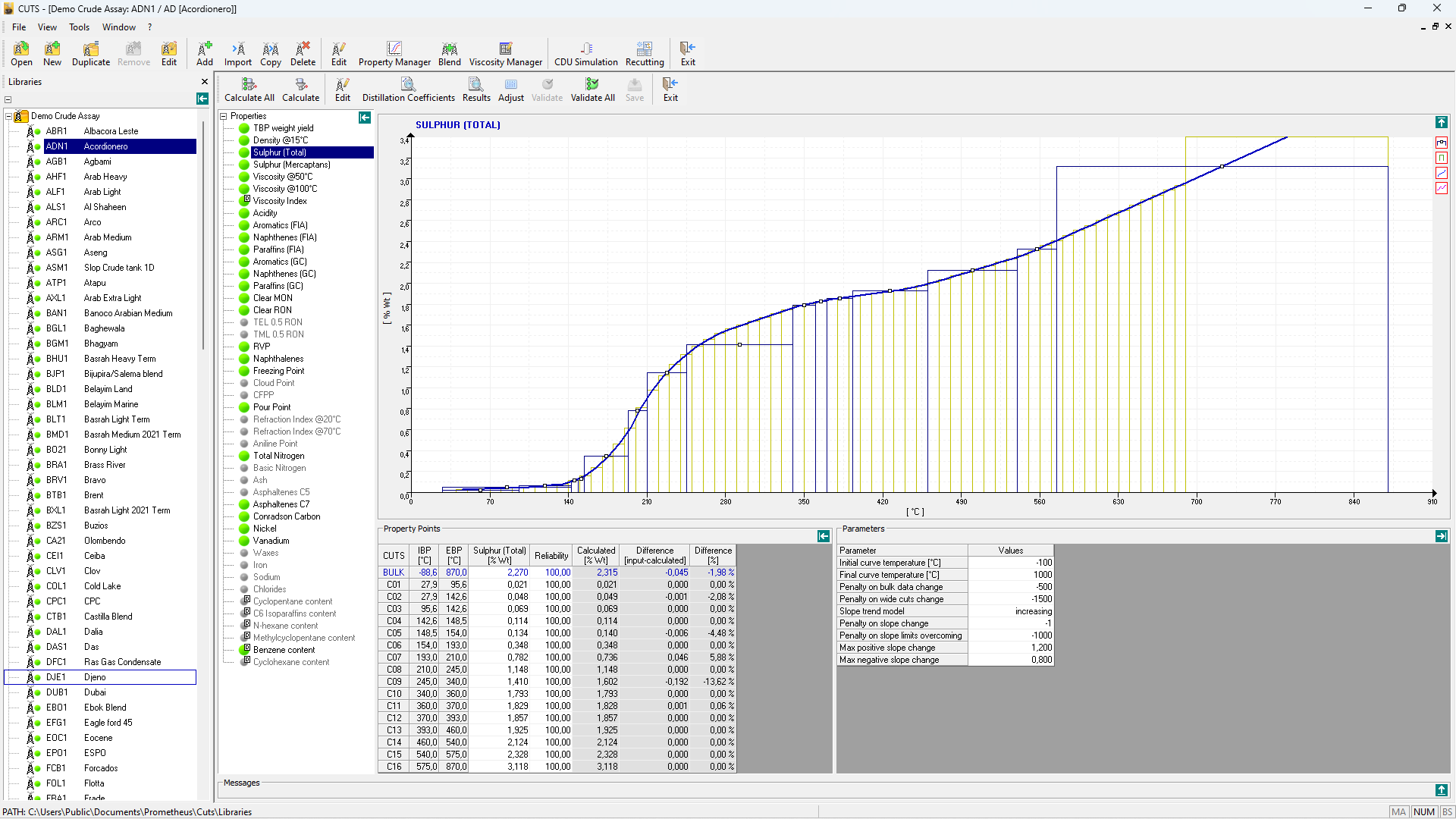
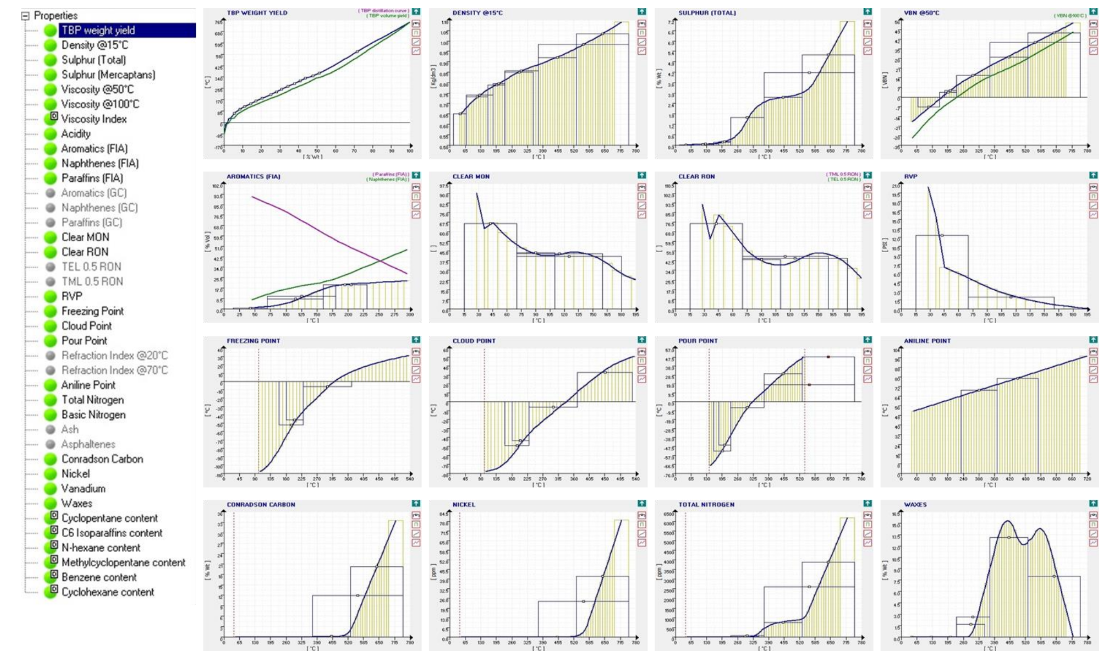
The regression distributes the reported crude oil properties over a continuous series of pseudo-components, preserving the natural shape of the TBP curve, the trends of the measured property curves, and the overall behaviour of the original assay. This approach allows reliable property estimation even when the available assay is incomplete or originates from different sources and reporting formats.
The result is a congruent crude assay database that can be queried for the properties of any required fraction. Instead of spending time manually reconciling laboratory data, engineers can work from a single, internally consistent crude oil characterization that provides a dependable basis for feedstock evaluation, crude selection, refinery planning, crude blending, LP optimization, and process simulation.


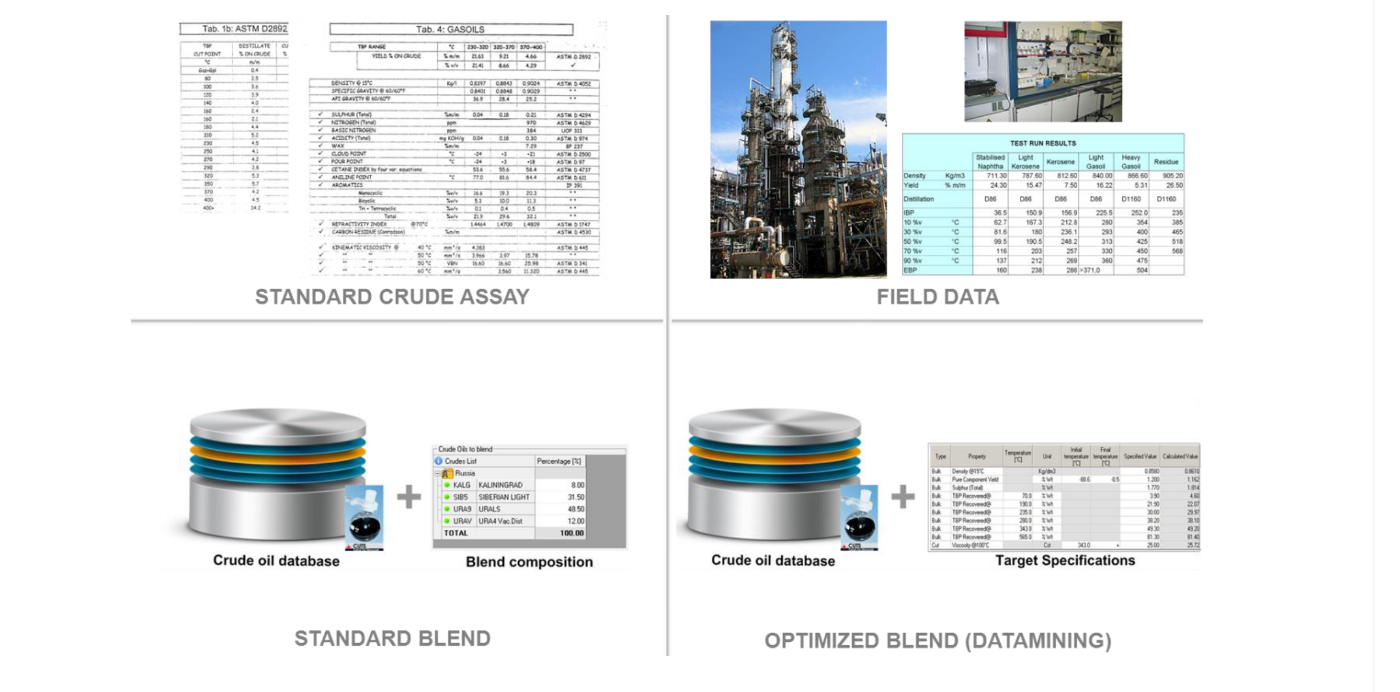
CRUDE DATA SOURCES
CUTS foresees four alternative Crude characterization modes, depending of the type of data available: standard input from a crude assay;
Crude oil is a highly complex mixture of thousands of hydrocarbon compounds that cannot be represented individually in refinery engineering models. For this reason, pseudo-components are widely used to describe groups of hydrocarbons with similar boiling characteristics and physical properties, providing a practical and consistent representation of the crude for engineering calculations.
CUTS automatically generates pseudo-components by dividing the crude into narrow 10°C cuts across the entire boiling range. For each fraction, the software calculates the appropriate crude oil properties, distributing the information contained in the original crude assay to achieve the best agreement with the natural shape of the reported property curves. The result is a continuous and internally consistent crude oil characterization, rather than a collection of isolated laboratory measurements.
Applications in Refinery Workflows
The value of a crude assay management software lies not only in generating a complete crude oil characterization, but also in making that information usable throughout the refinery. By providing a consistent and queryable crude assay database, CUTS establishes a common technical foundation that supports engineering studies and operational decision-making across multiple refinery disciplines.
For refinery planning and refinery scheduling, engineers require crude data that is internally consistent and directly comparable across different feedstocks. Working from a unified characterization helps eliminate discrepancies caused by inconsistent laboratory assays, allowing planning models to evaluate crude slates using the same technical basis. This improves confidence in production plans, scheduling decisions, and long-term refinery optimization studies.
During crude blending and feedstock evaluation, engineers often compare crude oils with different origins, qualities, and assay formats. CUTS enables these comparisons by representing every crude using the same continuous pseudo-component structure. A consistent description of crude oil properties simplifies crude selection, supports blend evaluation, and reduces uncertainty when assessing alternative feedstocks or changing crude supply conditions.
The detailed crude oil characterization generated by CUTS also provides reliable inputs for LP optimization and process simulation. By supplying internally consistent pseudo-component properties across the full boiling range, the software helps engineers prepare representative feed data for refinery models while maintaining consistency between different engineering studies.
By creating a single source of technically consistent crude information, CUTS reduces the effort required to prepare assay data for different applications and improves collaboration between planning, process, operations, and technical teams. Instead of maintaining multiple versions of the same crude, refinery professionals can rely on one consistent characterization throughout the engineering workflow.
CRUDE ASSAY ESTIMATION
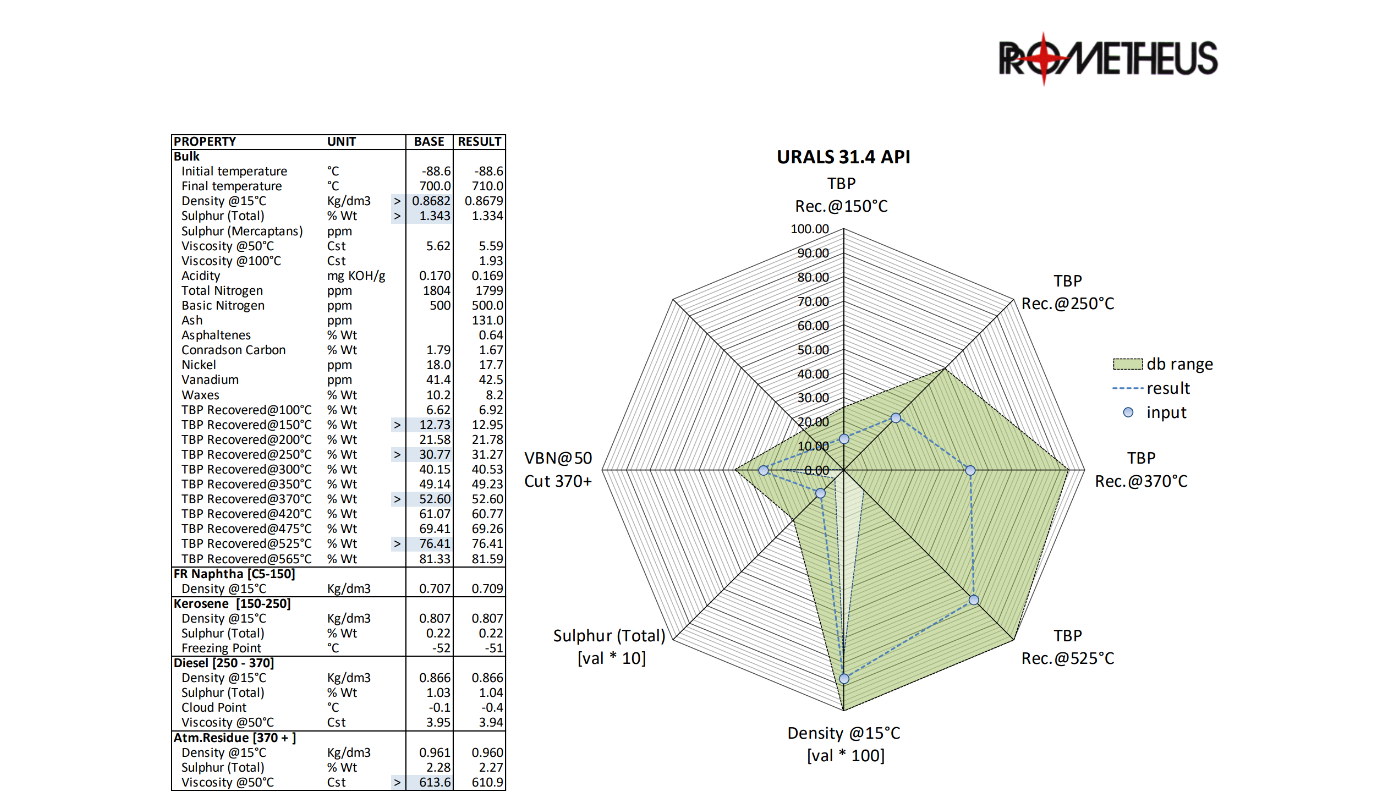
CUTS is able to generate a complete crude assay starting from a limited set of characterization data with the “Optimized Blend” feature. The process is carried out through two steps: • Selection of the set of crude oils contained in the database that will provide information during the data mining analysis. This step must be handled carefully since it determines the quality ranges that will be allowed for each specification during the analysis. The crude oils of the library must be properly filtered in order to assure a feasible range for any input specification and to control at the same time the degrees of freedom left to the algorithm. • Run of the data mining analysis targeting the characterization data available (e.g. Density, Sulphur Content, TBP distillation) and production of the set of pseudo-components best representing the current feedstock. The result is a comprehensive set of congruent data ready to reproduce exhaustively the behaviour of the feedstock in the following calculation modules (planning, scheduling, process design). The consistency of the characterization data produced by this approach is assured by the integrity of the information associated to each crude oil (or crude oil fraction) represented in the database that has been previously pre-processed by CUTS multidimensional regression. Figure 4 summarises the results of a test carried out to check the algorithm: the results obtained inputting few specifications of a known crude assay are compared with the crude assay itself. The table on at the left hand side compares the estimated results with the original assays. The seven values highlighted in the “base” column (Bulk Density, Sulphur, TBP Points, Atmospheric Residue Viscosity) constitute the algorithm input. The radar chart on the right hand side shows, for each input specification the ranges of the crude oils used for the analysis, the input value and the corresponding results. The library which have been selected to carry out this exercise based on URAL crude oil was composed of 12 components and precisely of 9 crude oils from the same country (Russia) and three oil fractions
Automatic Crude Recutting
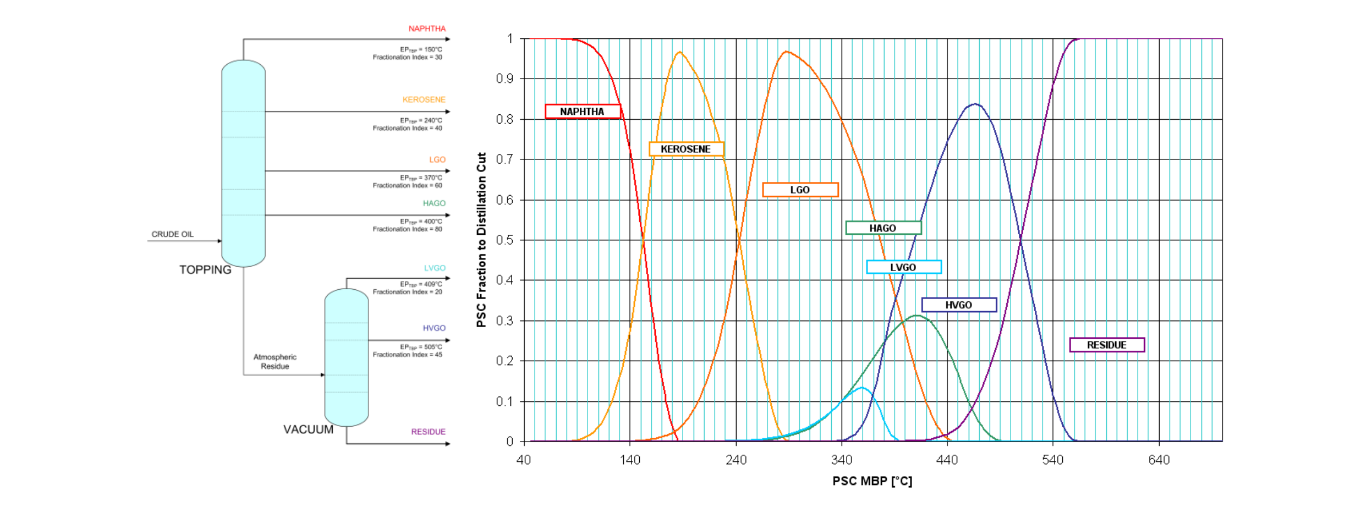
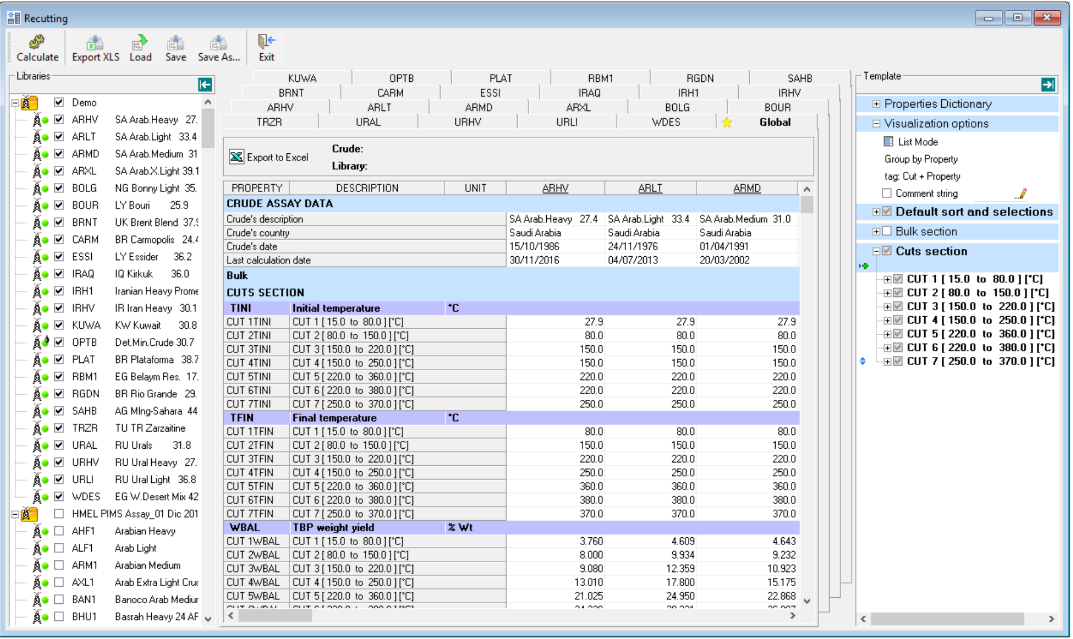
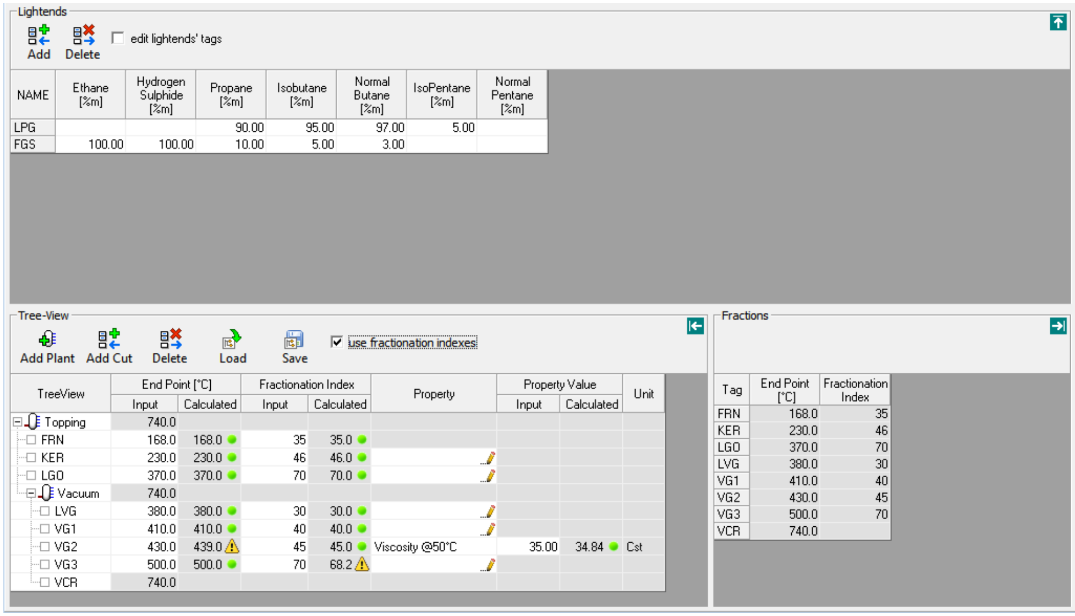
Laboratory crude oil assays are developed for specific testing purposes and therefore report properties at predefined cut points. In practice, however, refinery engineers often require different petroleum fractions to support refinery planning, crude blending, LP optimization, or process simulation. Rebuilding an assay manually each time a different fractionation scheme is required is both time-consuming and prone to inconsistency. CUTS simplifies this task through automatic crude recutting. Once a crude has been reconstructed as a continuous crude oil characterization, the software divides the entire boiling range into narrow 10°C cuts, represented as pseudo-components with consistent physical and chemical properties. This fine-resolution characterization provides the flexibility to recalculate properties for virtually any set of cut points without modifying the original laboratory assay. Because the recalculated fractions are derived from a single internally consistent model, engineers can evaluate different fractionation schemes while maintaining the integrity of the original crude assay. The resulting crude oil properties remain coherent across the entire boiling range, providing a dependable basis for feedstock evaluation, crude selection, refinery planning, refinery scheduling, and process simulation. Automatic crude recutting also simplifies collaboration between engineering teams. Whether different studies require broad distillation cuts or narrow process-specific fractions, every user works from the same underlying crude assay database, reducing manual data preparation, improving assay consistency, and ensuring that downstream engineering decisions are based on a common representation of the crude
Pseudo-Component Generation
Crude oil is a highly complex mixture of thousands of hydrocarbon compounds that cannot be represented individually in refinery engineering models. For this reason, pseudo-components are widely used to describe groups of hydrocarbons with similar boiling characteristics and physical properties, providing a practical and consistent representation of the crude for engineering calculations. CUTS automatically generates pseudo-components by dividing the crude into narrow 10°C cuts across the entire boiling range. For each fraction, the software calculates the appropriate crude oil properties, distributing the information contained in the original crude assay to achieve the best agreement with the natural shape of the reported property curves. The result is a continuous and internally consistent crude oil characterization, rather than a collection of isolated laboratory measurements. Unlike approaches that simply interpolate between reported values, CUTS generates contiguous pseudo-components whose properties remain consistent throughout the characterization. When required, operating parameters can be applied to further harmonize the resulting property curves while preserving consistency with the available assay data. This produces a reliable technical representation of the crude, even when the original assay is incomplete or contains measurements reported at different cut points. The generated pseudo-components form the foundation of the crude assay database, providing the detailed characterization required for feedstock evaluation, crude selection, refinery planning, refinery scheduling, crude blending, LP optimization, and process simulation. By working from a common set of internally consistent fractions, engineers can perform different studies using the same technical basis, improving confidence in both engineering analyses and operational decisions.
TBP Distillation and ASTM D86 Data
A reliable crude oil characterization is built from the laboratory data available for each crude oil assay. Among the most important sources of information are True Boiling Point (TBP) distillation data, ASTM D86 distillation results, and the associated physical and chemical properties reported for different petroleum fractions. Together, these measurements describe how the crude behaves across its entire boiling range and provide the basis for evaluating crude oil quality. In practice, however, laboratory assays rarely contain every property for every fraction. Different crudes may be characterized using different cut points, different test methods, or different levels of analytical detail. As a result, the available information often needs to be interpreted as a whole rather than treated as a collection of independent measurements. CUTS uses its proprietary multidimensional regression technology to reconcile the available assay data and distribute the reported crude oil properties across a continuous series of pseudo-components. The objective is to produce a technically coherent crude characterization that follows the natural behaviour of the reported TBP curve and other property trends while remaining consistent with the original laboratory information. The resulting characterization provides engineers with a complete and internally consistent representation of the crude, supporting assay validation, property estimation, feedstock evaluation, refinery planning, crude blending, LP optimization, and process simulation, even when the original assay contains incomplete or differently formatted laboratory data.
Discover the Latest Features and Resources
Check out the latest news, features, benifits, Frequently Asked Questions, and Integration with Existing Tools.


Business and Engineering Benefits
